

A free virtual summit where middle school ELA teachers learn to win back attention, one class period at a time. We would love to have you as one of our featured presenters.

The Engagement Games brings together experienced educators for one action-packed virtual event. Every session answers the same question: how do we get middle schoolers to actually care? Sessions are pre-recorded, 15 minutes long, and packed with strategies that are easy to bring into their own classrooms.

One quick thing before the details: the Games have a playful twist. Attendees vote for their favorite session, and one presenter is crowned Victor at the end. No rankings, no pressure, just a little friendly arena spirit.
Keep it 15 to 20 minutes, focused on ONE strategy, taught over-the-shoulder style.
This is not a "talk over a slide deck for 20 minutes" kind of summit. Teachers don't need another presentation about engagement. They want to watch someone actually DO the thing. So instead of telling us vocabulary games work, show us your favorite one. Pull up the actual game. Walk us through how you set it up, how you explain it to students, what it looks like mid-game, and what you do when it goes sideways. By the end, attendees should feel like they spent 20 minutes sitting next to you while you planned.
And "easy to implement" is the goal, whatever form that takes. Your strategy might be something teachers DO, like a discussion routine or a room transformation. Or it might be something teachers USE, like a done-for-you resource you walk them through. A print-and-go game, a ready-made unit launch, a template they fill in. Both are welcome in the arena. The only real rule: when your session ends, a teacher should know exactly what to do or grab to make it happen in her room.
Great sessions look like:
- Screen sharing while you build or customize the activity, so teachers see every click
- Walking through your actual materials: the handout, the slides, the game board, the anchor chart
- Filming your classroom setup and narrating why everything is where it is
- Demonstrating the strategy as if we're your students, then breaking down the teacher moves
- Showing real student work samples and explaining what the strategy produced
One strategy. Any corner of ELA.
Seriously, anything. If it happens in an ELA classroom and it gets middle schoolers to care, it belongs in the arena. To get your wheels turning:
- Games and competition: a review game that isn't Kahoot, a grammar tournament bracket, a full-class vocabulary showdown, turning test prep into a survival challenge
- Reading: a first-chapter Friday routine that hooks reluctant readers, annotation strategies students don't groan about, running a book tasting, making whole-class novels feel like events
- Writing: a peer feedback protocol students actually use, quick-write rituals, turning argumentative writing into a campaign or trial, publishing celebrations
- Discussion and talk: a Socratic seminar twist, silent discussion strategies, debate structures for shy classes, accountable talk that doesn't feel forced
- Classroom environment: a room transformation on a teacher budget, flexible seating that supports (not derails) instruction, bulletin boards students interact with, themed unit launches
- Routines and culture: bell ringers students race to start, brain breaks that refocus instead of derail, reward systems, music and lighting tricks, the first five minutes of class
- Vocabulary and grammar: doodle notes in action, mentor sentences, grammar in context routines, word walls that get used instead of ignored
- Tech and tools: one digital tool used brilliantly, not a tour of ten apps
Stick to one strategy. A teacher should leave your session with one clear thing to try or grab, not a list of seven tips to sort through later.
May the odds be ever in your favor. But mostly, have fun with this.






Do I need fancy recording equipment?
Can I pitch my own products?
Who owns my session?
Do I need to be there live?

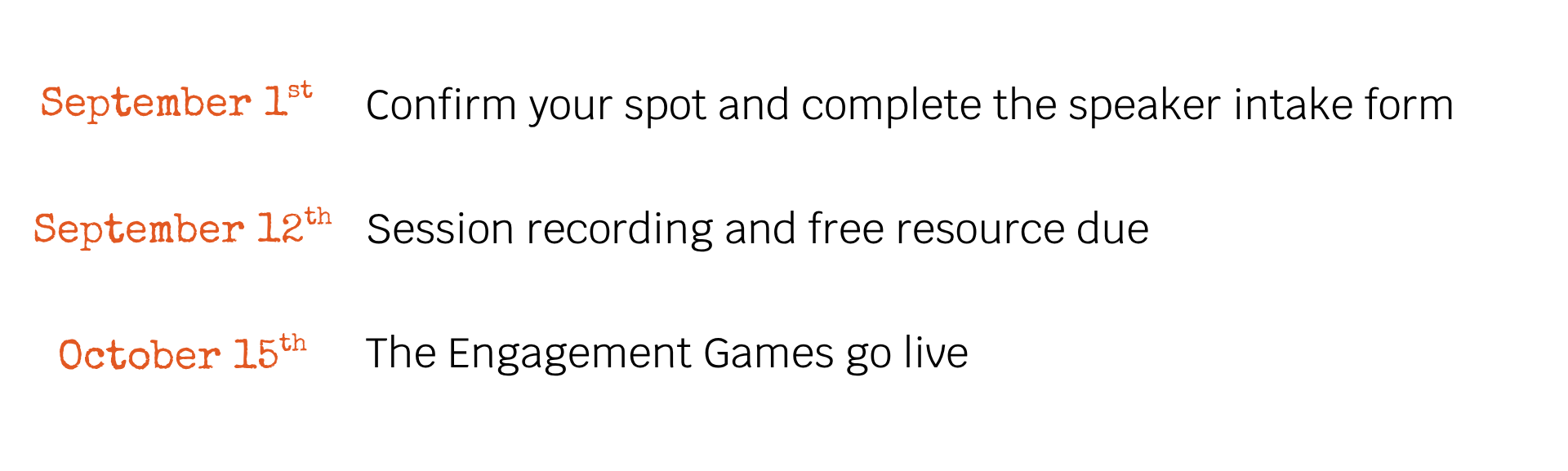
Consider yourself officially reaped, in the friendliest possible way. Confirm by August 31st, and the spot is yours.
Yes, count me in